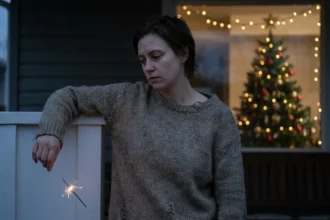



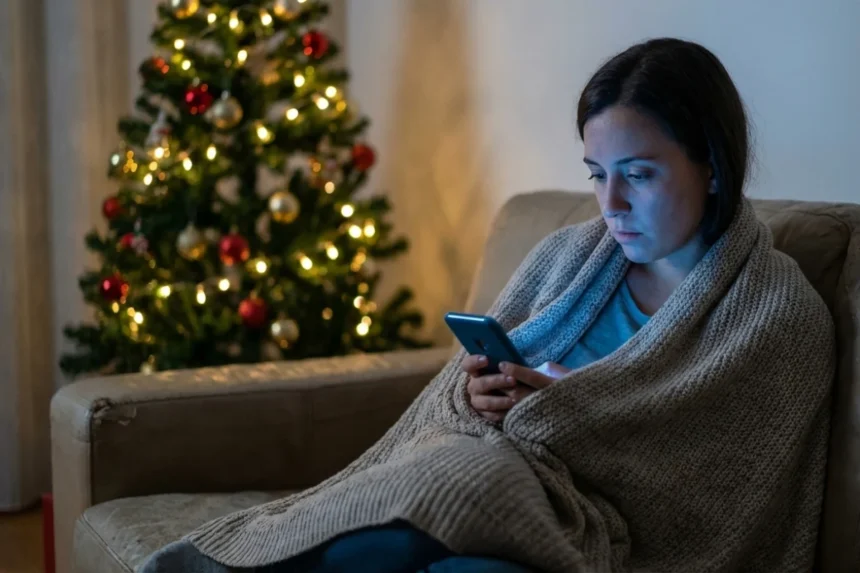
It happens in the quiet moments. You pick up your phone for a mindless scroll, and boom—there it is. A photo of a “Friendsmas” dinner you didn’t know was happening. Suddenly, you are feeling left out in a way that knocks the wind out of you.
That sinking, heavy sensation in your chest? It isn’t just jealousy. And you aren’t being dramatic.
Feeling left out during the holidays—a time explicitly marketed as the “season of belonging”—is a specific, sharp kind of pain. It triggers a primal alarm in your nervous system that screams, “I am not safe because I am not with the tribe.”
If you’re reading this with a knot in your stomach, take a deep breath. You aren’t broken. In fact, a 2025 survey found that 59% of adults agree the holidays magnify holiday loneliness more than any other time of year.
Here is why this hits so hard right now, and how to validate your own experience without spiraling.
The Science: Why Feeling Left Out Physically Hurts
First, let’s ditch the shame. Feeling left out isn’t a sign of social failure; it’s a sign that your biology is working correctly.
Think about our ancestors. Thousands of years ago, humans relied on the group for survival. If you were alone during the holidays (or the winter solstice back then), you probably wouldn’t make it. Because of this, our brains evolved to treat social rejection as a life-or-death emergency.
This isn’t a metaphor. Landmark brain imaging studies have shown that exclusion lights up the exact same regions of the brain as physical pain (like breaking a bone). The overlap is so specific that researchers could predict physical pain responses based on social distress with 88% accuracy.
So, when you see that photo, your brain registers it like a physical blow to the gut. You aren’t “too sensitive.” You are experiencing a biological reality.
The “Glass Wall”: The Reality of Holiday Loneliness
Psychologists often refer to December as the peak season for social comparison. It feels like everyone else is behind a glass wall—warm, laughing, and perfectly connected—while you’re stuck outside in the cold feeling left out.
But the data tells a different story.
Recent polls reveal that over 50% of people feel isolated during the holidays, even when they are physically sitting next to loved ones. The problem is that we compare our internal reality (our loneliness, our messy house, our fatigue) with everyone else’s external performance.
You are seeing their highlight reel; you are feeling your own behind-the-scenes.
Save this for later!
Pin this article to your “Self-Care” board so you can come back to it the next time social media makes you feel small.
3 Ways to Cope When Feeling Left Out
You cannot force an invitation, and you cannot control how others treat you. But you can control how you treat yourself in the aftermath.
Research shows that self-compassion can significantly reduce holiday loneliness. Here is how to offer yourself the validation you aren’t getting from the room.
1. Name It Without Shaming It
When we start feeling left out, our instinct is to shove it down. We tell ourselves, “I’m being pathetic,” or “I shouldn’t care about this.”
But suppressing the emotion just keeps the stress hormones circulating. It keeps the alarm ringing in your body.
The Fix:
Instead, name the emotion simply and quietly. Say to yourself, “I am feeling left out right now, and that hurts.” or “I’m sad because I wanted to be included.”
Validating the pain acts like a pressure valve. It tells your nervous system that you acknowledge the threat, which allows the wave of emotion to peak and then recede, rather than staying stuck in your chest.
2. Build Your “Inner Sanctuary”
If the world feels cold, you must make your immediate environment warm. Think of this as charging your internal battery when the external power source is cut off.
The NIH suggests that behavioral activation—doing simple, pleasant activities—can lower stress markers by up to 25%.
The Fix:
Treat yourself like an honored guest in your own home.
- Put on the good socks (you know the ones).
- Make your tea exactly how you like it.
- Watch the movie you want to watch, not what the group would pick.
By curating your own experience, you shift the narrative from “I was excluded from their joy” to “I am choosing to create my own peace.”
3. The “Common Humanity” Reality Check
When we are feeling left out, we tend to feel terminally unique—as if we are the only person on earth sitting alone on a Saturday night.
This is objectively false.
The Fix:
Remind yourself that right now, millions of people are feeling exactly what you are feeling. Surveys estimate that 1 in 5 adults feels lonely on a daily basis. You are connected to them through this shared human experience.
You aren’t the outcast; you are part of a massive, silent tribe of people getting through a difficult season.
The Bottom Line
The holidays will end. The parties will stop, the decorations will come down, and the performance of “perfect togetherness” will fade away.
But your relationship with yourself? That is permanent.
If you are feeling left out this season, please try not to abandon yourself in the process. Be the friend to yourself that you wish others were being to you. Validate the pain, wrap yourself in comfort, and remember: your worth is not determined by an RSVP list.
FAQs
Why does feeling left out hurt physically?
Feeling left out hurts physically because social rejection activates the same regions of the brain as physical pain, such as the anterior insula. Evolutionarily, isolation was a threat to survival, so the brain developed a “pain” alarm system to alert us when our social connection to the “tribe” is threatened.
Is it normal to feel lonely during the holidays?
Yes, it is extremely common. Recent surveys indicate that up to 59% of adults feel that the holidays magnify their loneliness. This is often driven by the “expectation-reality gap,” where the cultural pressure to be perfectly connected clashes with the reality of family dynamics or isolation.
How do I cope with being excluded?
To cope with exclusion, first validate the feeling (“I feel sad”) rather than suppressing it to lower stress hormones. Next, create an “inner sanctuary” by engaging in comforting self-care activities (like a hot bath or favorite movie), and remind yourself of “common humanity”—that millions of others feel the same way right now.
Why do I feel lonely even when I’m with family?
You can feel lonely in a crowd due to a lack of emotional safety or connection, known as “perceived isolation.” If you feel like an observer rather than a participant (the “glass wall” phenomenon), your brain registers loneliness even if you are physically surrounded by people.
Disclaimer: This article is for informational purposes only and is not a substitute for professional mental health advice. If feelings of loneliness are affecting your daily life, please consider reaching out to a therapist or counselor.