



It’s 7:00 AM, you’re looking in the mirror, and there it is—another red, angry flare-up that seems to have come out of nowhere. You’ve changed your pillowcases and tried every “miracle” cleanser on the shelf, but the spots remain. What if the real solution isn’t in your bathroom cabinet, but in your kitchen? There’s a fascinating, invisible conversation happening between your digestive system and your complexion known as the gut-skin axis. Once you learn how to listen, everything changes.
This idea that our skin reflects our inner health isn’t just an old wives’ tale; it’s a biological reality. Researchers Bowe and Logan pioneered a framework over a decade ago showing that our gut, our brain, and our skin are all part of one giant feedback loop. With 85% of us experiencing acne at some point and gut imbalances found in 40–60% of those cases, understanding the gut-skin axis is more important than ever. If you have been searching for the link between leaky gut and acne, you are finally looking in the right place.
Save this for later
Pull this up the next time your skin starts “talking” to you and you need a reminder of what to put on your plate.
The “leaky gut” connection and your complexion
To understand why a breakout happens, we have to look at intestinal permeability, or what’s often called “leaky gut.” Think of your gut lining as a secure gatekeeper. Its job is to let nutrients into your bloodstream while keeping waste out. However, when that lining becomes too permeable—sort of like a screen door with holes in it—tiny “intruders” like undigested food particles or bad bacteria can slip through.
According to Healthline, these intruders trigger your immune system to go on high alert. This creates systemic inflammation that doesn’t just stay in your stomach; it travels through your body and often shows up on your face. This is why conditions like rosacea, eczema, and psoriasis are so frequently linked to gut health. In a way, your skin is acting as a secondary exit for the “mess” happening inside. In fact, a leaky gut can actually triple your risk for these inflammatory skin issues.
The dairy-acne link: How hormones turn up the “oil knob”
You’ve probably heard people say that cutting out dairy cleared their skin. There’s hard science behind why that works, and it involves a hormone called Insulin-like Growth Factor 1 ($IGF-1$) and a signaling pathway called $mTOR$. Think of $IGF-1$ as a volume knob for your skin’s oil glands. When you consume dairy—especially skim milk and whey protein—your body’s levels of $IGF-1$ can spike by 20–30%.
This turns the knob way up on your sebum (oil) production. When you have too much oil combined with the systemic inflammation we mentioned earlier, you have the perfect recipe for a clogged pore. WebMD notes that for many adults, reducing dairy is one of the fastest ways to calm aggressive, cystic acne. Understanding the gut-skin axis means recognizing that what we drink can directly stimulate our oil glands.
Sugar, spikes, and sebum: Why high-glycemic foods trigger breakouts
It’s not just dairy that turns up the oil; high-glycemic foods are a major culprit, too. These are foods that turn into sugar in your bloodstream almost instantly. When your insulin levels “rocket” upward, it doesn’t just lead to an afternoon energy crash; it actually tells your skin to produce more oil and increases the activity of androgen hormones.
Common High-Glycemic Triggers:
- White bread, bagels, and pastries
- Sugary sodas and energy drinks
- Processed “white” cereals
- White rice and crackers
If you’ve ever noticed a flare-up a few days after a weekend of heavy “junk” food, your gut-skin axis is simply responding to that insulin surge. By choosing low-glycemic options, you are essentially telling your skin to stay calm.
Probiotics for skin health: Can you swallow your skincare?
If the bad news is that sugar and dairy can cause trouble, the great news is that specific “good” bacteria can help repair the damage. In recent studies, choosing the right probiotics for skin health has shown incredible results for clearing the complexion.
Why Lactobacillus rhamnosus is a game-changer for inflammation
One star of the show is Lactobacillus rhamnosus. Research shows that supplementing with this specific strain can reduce acne lesions by 32–50% by calming inflammation markers like $IL-6$. Essentially, it helps turn that “oil knob” back down to a normal level from the inside out. This proves that the gut-skin axis can be healed with the right microbial support.
Top fermented foods for gut diversity
Harvard Health emphasizes that while supplements are an option, you can foster a healthy microbiome with common fermented foods. These foods are a natural way to support the gut-skin axis every day:
- Yogurt and Kefir: Look for “live active cultures” and low added sugar.
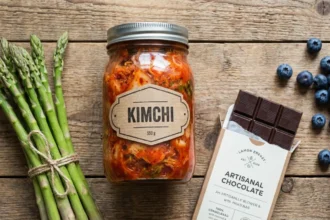
- Kimchi and Sauerkraut: Packed with probiotics that fight systemic inflammation.
- Miso and Tempeh: Great for gut diversity and fermented soy benefits.
Simple anti-inflammatory swaps for clearer skin
Improving your gut-skin axis doesn’t have to be a radical overhaul. You can start with these simple, daily swaps to calm inflammation and boost gut health:
- Swap White Bread for Sourdough: The fermentation makes it lower-glycemic and easier for your gut to process.
- Add More Fiber: Aim for 25–30g daily. This can lower systemic inflammation by 20%.
- Swap Whey Protein for Pea or Hemp Protein: Plant proteins don’t trigger that same $IGF-1$ hormonal spike.
- Incorporate Omega-3s: Eating fatty fish or taking fish oil can significantly reduce the inflammatory triggers of acne.
- Swap Soda for Kombucha: You get the fizz you want, plus a dose of gut-healing probiotics.
- Add “Prebiotic” Foods: Feed your good bacteria with garlic, onions, bananas, and oats.
Your skin isn’t “failing” you when it breaks out; it’s communicating with you. It’s a mirror reflecting the state of your internal ecosystem. By focusing on fiber-rich vegetables, healthy fats, and fermented foods, you aren’t just improving your digestion—you’re literally feeding your “glow” from the inside out. Treat your gut like a garden: pull the “weeds” of excess sugar and plant the “seeds” of probiotics. Your skin will naturally begin to bloom.
FAQs
What is the gut-skin axis and how does it affect the face?
The gut-skin axis is a biological feedback loop where digestive health reflects on the complexion. Intestinal permeability, or “leaky gut,” allows undigested food and bacteria to enter the bloodstream, triggering systemic inflammation. This often manifests on the skin as red flare-ups or conditions like acne, rosacea, and psoriasis.
Why does dairy cause acne according to scientific research?
Dairy, specifically skim milk and whey protein, spikes Insulin-like Growth Factor 1 ($IGF-1$) levels in the body. This hormone acts like a “volume knob” for oil glands, significantly increasing sebum production. Combined with systemic inflammation, this excess oil creates a perfect environment for clogged pores and cystic acne.
How do high-glycemic foods trigger skin breakouts?
High-glycemic foods like white bread and sugary sodas cause insulin levels to rocket upward. This spike tells the skin to produce more oil and increases androgen hormone activity. Consequently, the gut-skin axis responds to these insulin surges by triggering flare-ups and acne a few days after consumption.
Can probiotics improve skin health and clear the complexion?
Specific probiotics, such as Lactobacillus rhamnosus, have been shown to reduce acne lesions by 32–50%. These “good” bacteria help heal the gut-skin axis by calming inflammation markers like $IL-6$. This process helps naturally lower oil production and skin inflammation from the inside out.
What dietary swaps help support the gut-skin axis?
To calm inflammation, swap white bread for sourdough and whey protein for plant-based pea or hemp protein. Increasing daily fiber to 25–30g and incorporating omega-3s from fish oil also helps. Replacing sugary sodas with kombucha provides gut-healing probiotics that protect the skin from inflammatory triggers.
Disclaimer: This article is for informational purposes only. It is not a substitute for professional medical advice. Always consult with a healthcare professional or registered dietitian before making significant changes to your diet or starting new supplements, especially if you have underlying skin conditions or digestive issues.