



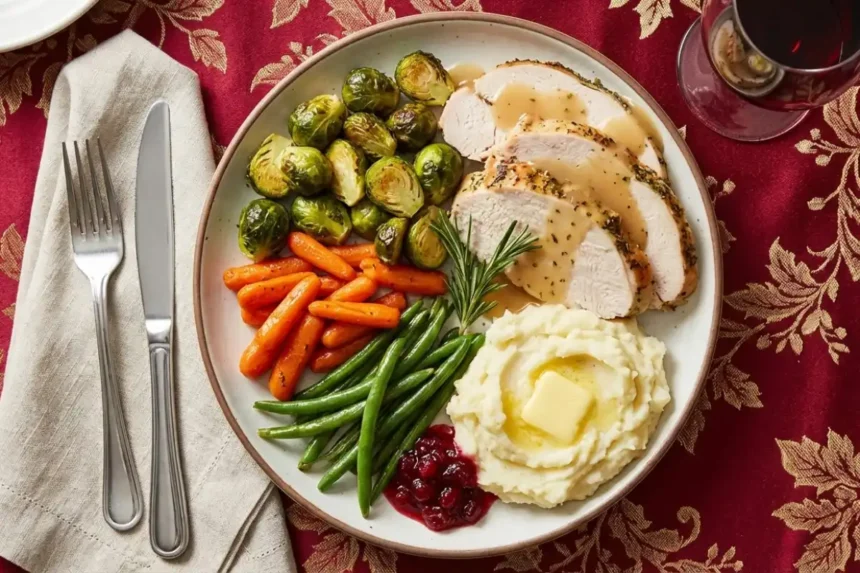
Picture the moment: You’re standing at the buffet line. Ahead of you lies a mountain of glazed ham, three types of potatoes, and stuffing. Your brain wants everything, but your stomach is already dreading the inevitable holiday food coma. Building a healthy Christmas plate is your secret weapon to enjoying the feast without the crash.
If you’re worried about the post-meal slump, you aren’t alone. Data shows that the average holiday meal packs nearly 4,000 calories, and 76% of adults report that their digestion worsens significantly during the season. To avoid bloating and fatigue, you don’t need to skip your favorites; you just need to change the geometry of your meal.
Here is how to build the perfect healthy Christmas plate using the science of portion control and balance.
Why “Eye-Balling” Beats Counting Calories
During the holidays, precise tracking is impossible. You don’t know how much butter is in the mash. Trying to guess will only drive you crazy.
Instead, we use the 50-25-25 Rule.
The goal isn’t restriction; it’s blood sugar management. When you assemble a healthy Christmas plate correctly, you prevent the massive glucose spike (and the crash that follows) that leaves you napping on the sofa.
How to Build a Healthy Christmas Plate (The 50-25-25 Rule)
Use this visual framework backed by Harvard Health to create a balanced holiday meal without needing a scale.
Step 1: The Foundation (50% Veggies)
Imagine drawing a vertical line down the middle of your plate. One entire half should be dedicated to Non-Starchy Vegetables.
This is your safety net. According to WebMD, fiber acts like a brake pedal for your digestion. It slows down sugar absorption and adds volume to your meal, triggering the stretch receptors in your stomach that tell your brain, “Okay, we’re full.”
Fill this side of your healthy Christmas plate with:
- Roasted Brussels sprouts
- Green beans (go for more beans, less creamy topping)
- Glazed carrots
- Fresh salad greens
Important Note: In this framework, potatoes and corn count as starches (carbs), not veggies!
Step 2: The Anchor (25% Protein)
Now, look at the remaining empty half of your plate. Divide that in half again. One of those quarters is for Protein.
Protein is the “anchor” of your meal. It’s the most satisfying nutrient you can eat. Healthline notes that protein requires more energy to digest than fat or carbs, giving your metabolism a slight boost. Plus, eating enough of it keeps the “hunger hormone” (ghrelin) quiet.
Fill this quarter with:
- Roast turkey (white or dark meat)
- Holiday ham
- Roast beef
- Lentil loaf or tofu
Step 3: The “Fun” Section (25% Carbs)
This is the quarter most people accidentally turn into the whole plate. This section is for Starchy Carbohydrates.
These are the comfort foods that make Christmas feel like Christmas. They are delicious, but they turn into sugar quickly in your bloodstream. By limiting them to 25% of the visual space on your healthy Christmas plate, you get to enjoy the taste without overwhelming your insulin response.
Fill this quarter with:
- Mashed potatoes
- Stuffing
- Mac & Cheese
- Dinner rolls
Pro-Tip: If you want potatoes and stuffing and a roll, go for it! Just take smaller scoops of each so they all fit within that single quarter-section.
The Secret Weapon: Eat in Order to Avoid Bloating
Once your healthy Christmas plate is built, how you eat it matters almost as much as what is on it.
To minimize digestive regret, try eating in this specific order:
- Vegetables first (Coat the stomach with fiber).
- Protein second (Signal fullness).
- Starches last (Enjoy the rich stuff).
The Data: Clinical trials have shown that eating veggies and protein before carbs can reduce post-meal blood sugar spikes by 37%. It’s a simple sequencing trick that makes the difference between needing a nap and having energy for games.
A Quick Note on “Liquid Calories” (Gravy)
Sauces are often where the hidden sugar and salt live.
- Gravy: Just one tablespoon can pack 340mg of sodium. Use the “drizzle, don’t drown” method to avoid the salt bloat.
- Cranberry Sauce: Commercial versions can have 22g of sugar in just a ¼ cup. Treat it like a condiment (like ketchup), not a side dish. A dollop gives you the flavor without the crash.
The Bottom Line
The holidays come once a year. One meal where the ratios are a little off won’t ruin your health.
But using this visual framework gives you a sense of control. It allows you to participate in the celebration and eat the foods you love, but in a way that respects your body’s biology.
When you finish your healthy Christmas plate, you shouldn’t feel like you need to undo your pants. You should feel fueled, happy, and ready to enjoy the rest of the evening. Build your plate with purpose, and enjoy every bite.
FAQs
What is the 50-25-25 rule for holiday eating?
The 50-25-25 rule is a visual portion control method: fill 50% of your plate with non-starchy vegetables (like Brussels sprouts or salad), 25% with lean protein (turkey or ham), and limit starchy carbohydrates (potatoes, stuffing, rolls) to the remaining 25%. This balance helps regulate blood sugar without calorie counting.
Does eating vegetables first help digestion?
Yes. Research indicates that consuming vegetables and protein before starchy carbohydrates can reduce post-meal blood sugar spikes by up to 37%. Eating fiber first coats the stomach lining and slows down the absorption of glucose, preventing the energy crash often associated with heavy holiday meals.
How can I avoid a food coma on Christmas?
To avoid a food coma, prioritize blood sugar management. Use the “healthy plate” method to limit high-glycemic carbs, eat slowly to allow satiety signals to reach the brain, and avoid excessive alcohol. Taking a short, gentle walk after dinner can also help lower blood glucose and stimulate digestion.
Is gravy bad for bloating?
Gravy is often a primary cause of holiday bloating due to its high sodium content—a single tablespoon can contain nearly 340mg of salt. Excess sodium causes water retention. To minimize bloating, use the “drizzle, don’t drown” technique, treating gravy as a condiment rather than a soup.
Disclaimer: This article is for informational purposes only and is not a substitute for professional medical or nutritional advice. If you have specific dietary conditions like diabetes, please consult your healthcare provider.