


Have you ever woken up, swung your legs out of bed, and felt like the Tin Man from The Wizard of Oz before he found his oil can?
Maybe you let out a little groan when you stand up from the couch. Maybe reaching for the top shelf in the kitchen feels like an Olympic event. Or perhaps checking your blind spot while driving requires turning your whole torso because your neck just won’t go that far anymore.
If this sounds familiar, you aren’t alone.
In fact, studies show that over 54% of older adults report significant issues with stiff joints. We often brush this off as just “getting old.” We tell ourselves we’re just creaky.
But here is the truth: You aren’t broken. You’re just stiff.
When we feel tight, our instinct is to stretch. We try to touch our toes or pull an arm across our chest. And while stretching feels nice, it’s only half the battle. If you want to stay independent, prevent falls, and move without pain, you need to understand the balance of mobility vs. flexibility.
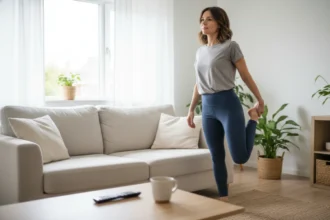
If you hate the gym or feel intimidated by the idea of “working out,” this is for you. Let’s break down why movement is the secret sauce to aging well—and look at a simple, sweat-free routine you can do right in your living room.
What Is the Difference Between Mobility vs. Flexibility?
We use these words like they mean the same thing, but they don’t. Knowing the distinction is the key to fixing those creaky areas.
Flexibility is passive. It’s the ability of your muscles to lengthen. Think of a rubber band being pulled.
- Example: You lie on your back, and someone lifts your leg high in the air. That’s flexibility.
Mobility is active. It’s the ability to control your body using your own strength. It’s strength plus flexibility.
- Example: You stand up and lift that same leg high in the air without using your hands. That is true joint mobility.
Why does this matter?
Imagine you slip on an icy sidewalk. Flexibility might let your legs do the splits. But mobility gives you the strength and control to catch yourself, stabilize your hip, and stop the fall before it happens.
According to the American College of Sports Medicine (ACSM), maintaining this kind of neuromotor fitness is the single most important factor in keeping your independence as you age.
Why Joint Stiffness Happens (The “Use It or Lose It” Rule)
We usually dismiss stiffness as just an annoyance. But the data shows it’s actually a “check engine” light we shouldn’t ignore.
The biggest risk as we lose our range of motion is falling.
- The Reality: More than 1 in 4 adults over age 65 falls every single year.
- The Risk: Falling once roughly doubles your chance of falling again.
- The Consequence: Sadly, up to 60% of older adults never fully regain their previous movement patterns after a serious fall.
I don’t tell you this to scare you. I tell you this to empower you. Research consistently shows that people who utilize mobility exercises regularly have fewer falls than those who don’t. You are building a safety net for your future self.
The “WD-40” Effect
But when we sit all day—in the car, at the desk, on the couch—that fluid doesn’t move. The joints get “dry.” Eventually, your brain says, “Well, we never use this range, so I’ll just tighten these muscles to save energy.”
The Mayo Clinic emphasizes that gentle movement is the best medicine. It reminds your body, “Hey! I still need to use this joint! Keep it loose!”
5 Beginner Mobility Exercises for Stiff Joints
You don’t need gym clothes. You don’t need to get on the floor if you can’t. You can do these while the coffee is brewing. The goal isn’t to burn calories; it’s to oil your joints.
Note: Move slowly. A little tension is okay, but if you feel sharp or pinching pain, stop immediately.
1. The “Yes/No” Neck Reset
We live looking down at phones. This locks up the cervical spine.
- How to do it: Sit or stand tall. Slowly look all the way to the right, then the left (shaking your head “no”). Then, look up to the ceiling, and tuck your chin to your chest (nodding “yes”).
- The Secret: Don’t just let your head flop. Use your neck muscles to actively pull your chin down or turn your head as far as it can comfortably go.
- Repetition: 5 times each way.
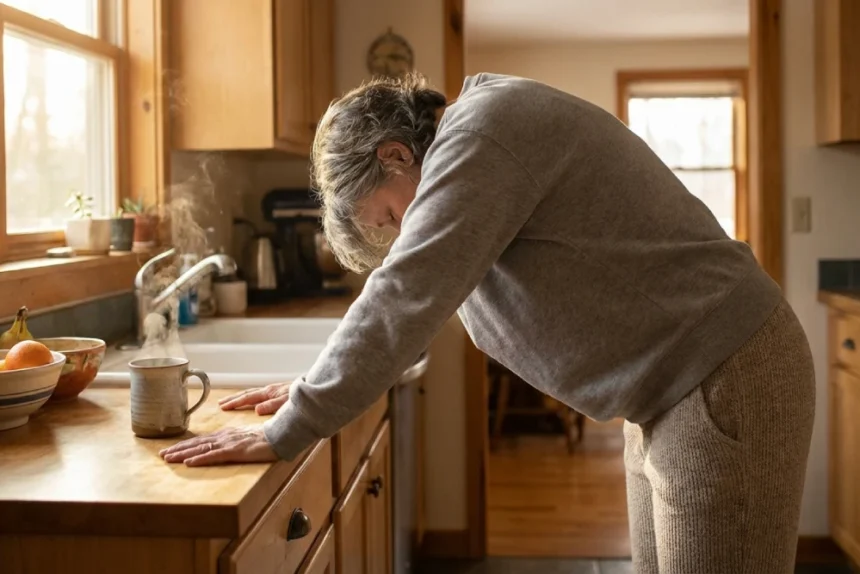
2. The Kitchen Counter “Cat-Cow”
You’ve probably seen people do this on their hands and knees in yoga. Good news: you can do it standing up at your kitchen counter. This wakes up your spine—vital for the 32% of older adults who struggle with low back stiffness.
- How to do it: Place your hands on the counter. Walk your feet back a little.
- Move A: Round your back up toward the ceiling like a scared Halloween cat, tucking your chin.
- Move B: Drop your belly toward the floor, arching your back gently and looking up.
- Repetition: Move back and forth slowly 8–10 times.
3. Shoulder Circles
Shoulder injuries are common because we rarely reach over our heads anymore.
- How to do it: Stand with arms at your sides. Lift your shoulders to your ears, roll them back (squeeze those shoulder blades!), drop them down, and roll forward.
- The Secret: Make the circle HUGE. Imagine touching every corner of a square box with your shoulders.
- Repetition: 10 circles backward, 10 forward.
4. The Seated Hip March
Tight hips are the number one complaint of sitters. This builds strength while greasing the joint.
- How to do it: Sit in a sturdy chair with feet flat. Lift one foot off the ground as high as you can without leaning backward. Hold for two seconds. Lower slowly. Switch legs.
- Repetition: 10 lifts per leg.
5. Ankle Rolls
Your ankles are the first line of defense against tripping. If they’re stiff, your balance is compromised.
- How to do it: Sit or stand (holding a wall). Lift one foot slightly. Draw the biggest alphabet “O” you can with your big toe.
- The Secret: Move only the foot, not the leg. Reach the very edges of the circle.
- Repetition: 10 circles each way.
The Power of “Exercise Snacks” for Longevity
If you’re intimidated by the idea of a 45-minute workout, here is the best news science has to offer: You don’t need to do it all at once.
Research on “Exercise Snacks”—brief bursts of activity lasting just a few minutes—shows they can significantly improve your fitness and endurance.
The Cleveland Clinic suggests that breaking movement into chunks is just as effective as one long session. For this type of training, frequency is actually better than intensity.
Try Snacking on Movement:
- The Morning Brew: Do neck rolls while the coffee machine runs.
- The Bathroom Break: Do 5 hip marches before leaving the bathroom.
- The TV Commercial: Do shoulder rolls during the ad breaks.
FAQs
What is the difference between mobility and flexibility?
Flexibility is the passive ability of a muscle to lengthen (like pulling a rubber band). Mobility is the active ability to control your body through a range of motion using strength. While flexibility allows you to get into a position, mobility gives you the strength to move in and out of it safely.
Why do joints get stiff as we age?
Joint stiffness is often caused by inactivity rather than age itself. Joints rely on synovial fluid for lubrication, similar to motor oil. When you sit for long periods, this fluid does not circulate, causing joints to feel “dry.” Gentle movement pumps this fluid back around the joint, relieving stiffness.
What are the best mobility exercises for beginners?
Effective beginner mobility exercises focus on lubricating major joints without heavy strain. Top moves include shoulder circles to fix posture, “Cat-Cow” stretches (using a counter) for spinal health, seated hip marches to loosen tight hips, and ankle rolls to improve balance and prevent falls.
How often should you do mobility exercises?
Unlike heavy weightlifting, mobility exercises can and should be done daily. Research supports the concept of “exercise snacks”—short, 1–5 minute bouts of movement spread throughout the day. Consistency is more important than intensity; aiming for a few minutes every morning or during breaks is highly effective.
The Bottom Line
You do not need to become a gym rat to save your body. You just need to move.
Think of this work as an investment account. Every time you circle your ankles or march your hips, you make a deposit. You are buying yourself the ability to tie your own shoes at 80, the strength to pick up your grandkids, and the confidence to walk down the street without fear.
Start small. Start today. Your future self will thank you for it.
Disclaimer: This blog post is for informational purposes only and does not constitute medical advice. Always consult with a healthcare professional before starting any new exercise routine.