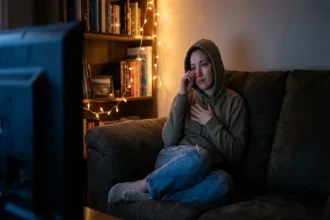



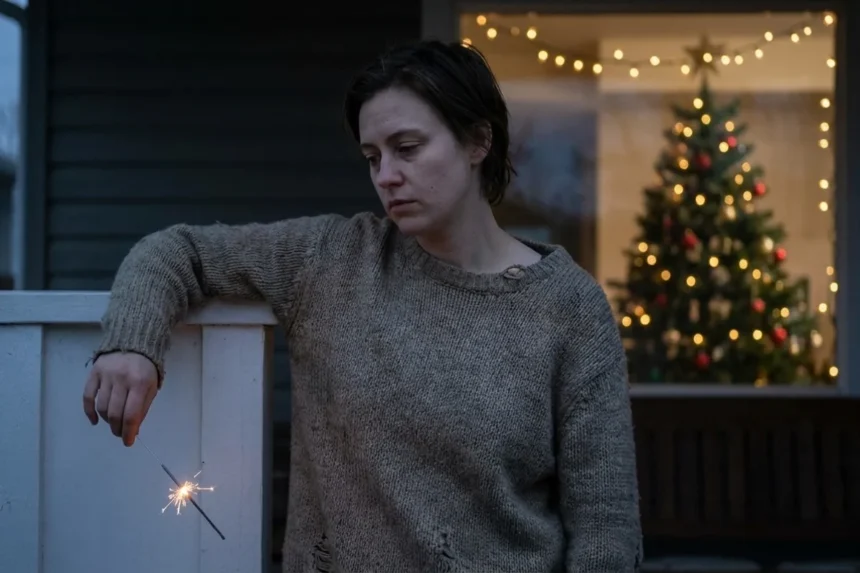
You’re walking through the grocery store. Tinsel is everywhere. Aggressive holiday pop music is blasting. But instead of feeling magical, you feel nothing. Or worse, you feel irritated and exhausted. If you are not feeling festive right now, I want you to know something important: You aren’t broken.
If the “most wonderful time of the year” feels more like an endurance test, you aren’t a Scrooge. You are likely experiencing holiday burnout or sad during the holidays.
There is a specific psychological phenomenon that happens when your internal reality doesn’t match the external world’s demand for joy. If you are not feeling festive, here is the science behind why, and a survival guide to help you protect your mental health during the holidays.
The Psychology of Not Feeling Festive (Festive Dissonance)
Psychologists call this Cognitive Dissonance. It’s the mental discomfort you feel when you hold two conflicting realities.
In December, the world screams that you should be happy. But if your reality is grief, burnout, or financial stress, the gap between “what is” and “what should be” creates immense pressure. Not feeling festive isn’t an attitude problem; it’s a reaction to this gap.
According to a 2023 survey by the American Psychological Association (APA), 41% of adults say their stress increases during the holidays. Even more telling? 89% cite at least one significant stressor right now. When you force yourself to “fake it,” you engage in emotional labor, depleting your energy and leading to holiday burnout.
3 Biological Reasons You Feel Sad During the Holidays
It isn’t just an attitude problem. Often, not feeling festive is a biological or situational response to specific triggers.
1. The “Empty Chair” Syndrome (Grief)
The holidays are markers of time. If you’ve lost someone, a job, or a relationship this year, the festivities highlight that absence.
You are part of a massive, silent group: National polls indicate that up to 40% of adults don’t want to celebrate due to grief. The NHS notes that grief often spikes during anniversaries, making not feeling festive a natural brain response to loss.
2. Your Brain Misses the Sun (SAD)
It might just be biology. Seasonal Affective Disorder (SAD) affects about 5% of U.S. adults. The National Institute of Mental Health (NIMH) explains that reduced sunlight can drop your serotonin (mood) and mess with your melatonin (sleep). You aren’t being “grumpy”; your brain is literally craving sunlight.
3. Sensory Overload
For highly sensitive people, the flashing lights and constant noise trigger the nervous system’s fight-or-flight response. Your “lack of spirit” might actually be a protective mechanism called shutting down.
Save this for later!
Pin this article so you have these coping strategies ready when the holiday overwhelm hits.
3 Tools to Cope When You Are Not Feeling Festive
You don’t need to force yourself to be the life of the party. Coping with holiday stress is about getting through the month without abandoning yourself.
1. Challenge the “Shoulds” (CBT)
The biggest enemy when you are not feeling festive is the word “Should.”
- “I should go to that party.”
- “I should feel happy.”
The Fix:
Swap “Should” for “Choose.”
Studies on Cognitive Behavioral Therapy (CBT) show that reframing rigid thoughts can calm the brain’s fear center.
- Old Thought: “I have to go.”
- New Thought: “I choose to go for one hour, then I choose to leave.”
This restores your sense of autonomy.
2. The “Bookend” Technique
If you have to attend an event that drains you, use this boundary technique. Think of the stressful event as the filling in a sandwich. You need to put two slices of calm bread around it.
- Before: Spend 15 minutes in a quiet room doing deep breathing.
- The Event: Attend the family dinner.
- After: Immediately change into comfortable clothes and decompress alone.
3. Practice “Sensory Grounding”
When you feel that wave of “I don’t belong here,” bring yourself back to the present.
Try the 5-4-3-2-1 Technique:
Look around and name 5 things you see, 4 you touch, 3 you hear, 2 you smell, and 1 you taste. This isn’t just a distraction. Clinical studies show that grounding techniques can reduce anxiety scores significantly. It’s a manual reset that forces your brain to come back online when you are not feeling festive.
Redefining Your Holiday Burnout
Perhaps the most powerful thing you can do is give yourself permission to opt out of the “Traditional Holiday.”
The World Health Organization (WHO) emphasizes that mental well-being is fundamental to health. If a tradition hurts your mental health, it is not a tradition worth keeping. You are allowed to order takeout instead of cooking. You are allowed to stay in pajamas. You are allowed to treat it like just another Tuesday.
The Bottom Line
If you are not feeling festive, please stop punishing yourself for it. Your feelings are valid data telling you what you need—whether that is rest, quiet, or solitude.
The lights will come down, the music will stop, and the season will pass. Until then, protect your peace. You don’t have to sparkle to be worthy of the season; you just have to survive it. And you will.
FAQs
Why do I not feel festive this year?
Not feeling festive is often caused by “festive dissonance”—the psychological conflict between the pressure to be happy and internal realities like burnout, grief, or financial stress. Biological factors like reduced sunlight (Seasonal Affective Disorder) and sensory overload from holiday environments also trigger the nervous system to shut down.
Is it normal to feel sad during the holidays?
Yes, it is extremely common. According to the American Psychological Association, 41% of adults report increased stress during the holidays. Additionally, up to 40% of people experience the “Empty Chair Syndrome,” where grief and loss are magnified by seasonal rituals, making sadness a normal reaction to the season.
How can I cope with not feeling festive?
To cope, practice “cognitive reframing” by replacing rigid “I should be happy” thoughts with “I choose to rest.” Use the “bookend technique” by scheduling quiet time immediately before and after social events, and give yourself permission to opt out of traditions that drain your mental health.
What is the “Empty Chair Syndrome”?
“Empty Chair Syndrome” refers to the acute grief experienced during holidays when a loved one is missing due to death, breakup, or estrangement. The brain associates seasonal rituals with specific people, causing a spike in sadness and “not feeling festive” even years after the loss occurred.
Disclaimer: This article is for informational purposes only and is not a substitute for professional mental health advice, diagnosis, or treatment. If you are experiencing persistent depression or thoughts of self-harm, please contact a medical professional or call a local crisis helpline immediately.