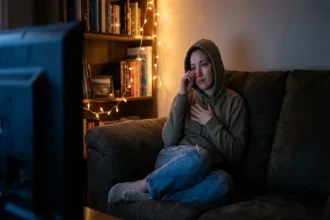



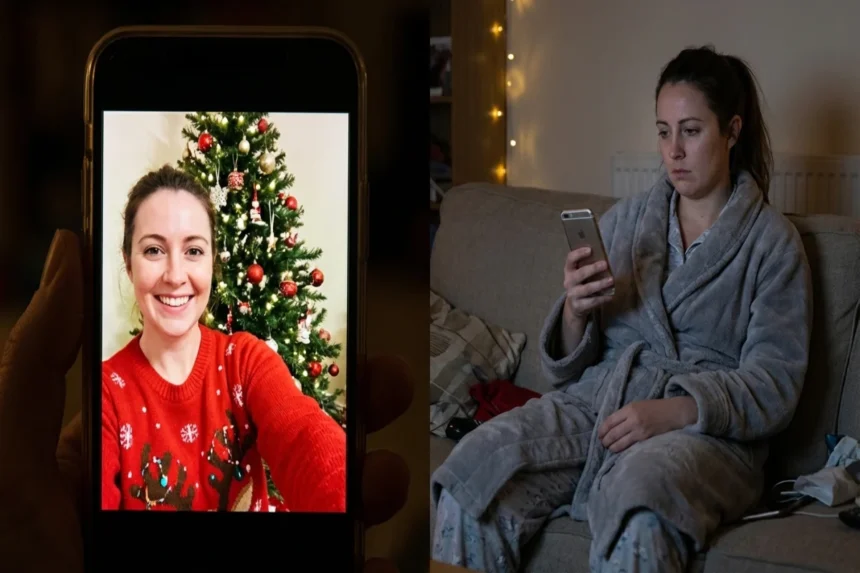
It is 9:00 PM on a Tuesday. You’re on the couch in your pajamas, totally drained. You pick up your phone to “relax,” but within minutes, your mood tanks. If social media holiday stress is spiking your anxiety right now, you aren’t alone.
You see a friend’s perfect family photo and an influencer’s flawless tree. Suddenly, the peace is gone. This Instagram anxiety is part of a massive trend. New data reveals that 76% of people turn to apps for inspiration, yet 89% report feeling stressed.
The tool we use to plan the holidays is often the thing ruining them. Here is the science behind why social media holiday stress hits so hard in December, and how to reclaim your peace.
The Science of Social Media Holiday Stress (Passive Scrolling)
To understand why your phone hurts right now, look at how you use it.
There is a big difference between active use (messaging a friend) and passive use (silently doom-scrolling). A major analysis of over 50 studies found a consistent link between passive scrolling and holiday depression.
Why? The Social Comparison Game.
Psychologists know that humans determine self-worth by comparing themselves to others. We used to compare ourselves to neighbors. Now, algorithms feed us the top 1% of holiday lives. This mechanism is the engine of social media holiday stress.
When you see “perfect” content, your brain creates a benchmark that is impossible to reach. You aren’t just seeing a photo; you are subconsciously grading your own life and giving yourself a failing mark.
The “Highlight Reel” Distortion
This pressure hits women hardest. Data shows 44% of women report high stress compared to 31% of men, often driven by the pressure to create “Instagram-worthy” magic.
The problem is that Instagram is a liar. It removes context.
- You see the beautiful dinner table, but not the argument that happened five minutes before.
- You see the pile of gifts, but not the credit card debt used to buy them.
This creates Cognitive Dissonance—a mental conflict that feels like stress. You’re comparing your messy “behind-the-scenes” footage (the laundry, the fatigue) with everyone else’s polished “highlight reel.” This distortion fuels social media holiday stress by making you feel like the only one struggling.
Why FOMO is Physical Pain
The holidays are peak season for gatherings, which triggers FOMO (Fear Of Missing Out). But FOMO isn’t just a slang term; it’s a biological event.
Humans are wired for the tribe. Historically, being left out meant death. When you see photos of a “Friendsmas” you missed, your brain processes it as social exclusion.
Brain scans actually show that social rejection lights up the pain matrix—the exact same region that activates when you break a bone. Even if you didn’t want to go to the party, seeing it happen without you physically hurts.
The Dopamine Loop: Why You Can’t Put It Down
If scrolling makes us feel bad, why do we do it?
Tech platforms use a Variable Reward System, just like a slot machine. You scroll through boring posts until—boom—you find one that is interesting. This releases a hit of dopamine in your brain.
During the holidays, your brain craves that dopamine to soothe stress. You pick up the phone to feel better, but because of the comparison trap, you end up feeling worse. It becomes a vicious cycle that amplifies social media holiday stress: Stress → Scroll for Dopamine → Feel Inadequate → More Stress.
3 Ways to Stop Social Media Holiday Stress
You don’t have to throw your phone in a snowbank to lower your anxiety. You just need to set some boundaries to manage social media holiday stress effectively.
1. The “Mute” Strategy
You are the curator of your feed. If a specific account—whether it’s an influencer or a family member—makes you feel anxious, mute them until January.
- The Science: Studies show that restricting social media use for just four weeks can significantly reduce depression symptoms. You can’t compare yourself to what you can’t see.
2. Create Before You Consume
Make a rule: No scrolling through other people’s holidays until you have done something real in your own day.
- The Habit: Drink your coffee, talk to your partner, or wrap one gift before you open the app.
- Why it works: This grounds you in your own reality first, creating a buffer against the digital distortion of social media holiday stress.
3. The Reality Check (Reframing)
Use a therapy technique called “Reframing.” For every perfect image you see, remind yourself of the effort behind it.
- The Thought: “Look how perfect their life is.”
- The Reframe: “That is a staged photo. It likely took three hours and a ring light to get that shot.”
The Bottom Line
Your holiday experience is valid, even if it isn’t “aesthetic.”
The mess, the noise, and the quiet moments on the couch are real life. Instagram is just a gallery. With 87% of Gen Z using social media for holiday ideas, the pressure to perform is higher than ever.
But you have a choice. You can measure your joy by how it feels, not by how it looks in a square photo. Put the phone down, and be where you are to finally beat social media holiday stress.
FAQs
Why does social media cause holiday stress?
Social media holiday stress stems from “Social Comparison Theory,” where users compare their messy, behind-the-scenes reality with others’ curated “highlight reels.” This creates cognitive dissonance and feelings of inadequacy. Research links passive scrolling (consuming content without interacting) directly to increased rates of anxiety and seasonal depression.
How can I stop feeling jealous of holiday posts?
To stop jealousy, curate your feed aggressively. Use the “mute” function on accounts that trigger inadequacy so you don’t see their content without unfollowing. Additionally, practice the “reality check” technique: remind yourself that perfect images are staged performances, often requiring hours of effort, lighting, and filters to create.
What is the “Highlight Reel” effect?
The “Highlight Reel” effect describes the distorted reality on social media where users share only their peak, happy moments while omitting struggles like debt, family arguments, or exhaustion. Comparing your full, complex life to these filtered snippets creates unrealistic expectations and a false sense of failure.
Why does FOMO feel physically painful?
FOMO (Fear Of Missing Out) hurts because humans are evolutionarily wired for connection. Neuroimaging studies show that social exclusion activates the brain’s anterior cingulate cortex—the same region that processes physical pain. Seeing events you missed triggers a biological “threat” response, causing genuine physiological distress.
Disclaimer: This article is for informational purposes only and is not a substitute for professional mental health advice. If social media use is negatively impacting your daily life or mental well-being, please consult a qualified therapist or counselor.